

Sitting before a plate of empty oyster shells, the ice melting, I look at the tide table on my phone. It’s still hours before I can catch the ebb tide, spilling out of Little Peconic and Great Peconic Bays through the strait between Greenport and Shelter Island, which will push me to Sterling Basin and my father’s tombstone.
The Little Creek Oyster Bar & Farm is filling with patrons, milling for a bar seat or a spot at one of the handful of tables. I love the fact that this handsome restaurant, which began a few years ago as a shack on the waterfront, is run by a collective of farmers, looking for a direct outlet for their oysters.
I don’t want to hold up a spot while eager folks from The City stand waiting. I pay the bill, nod to the shuckers, and again hit the streets.
Tourist-packed New Greenport is beginning to wear on me. It’s standing room only at Claudio’s event tent on the main pier, where the live music is too loud to think and the super-yachts and slick speed boats jockey for mooring spaces before the gawking crowd. I leave the waterfront.
I find the only dive bar left in Greenport, the Whiskey Wind Tavern, and drop quarters into the slot on the pool table.
I played pool a lot as a kid. But rediscovered the game – and got darn good at it – when running sailing ship organizations. In port, playing pool in bars was a great way to stay in touch with the crew members.
It’s been years since those Tall Ship days, but I nearly run the table, playing alone in the empty bar.
“Looks like you might be missing the seven ball,” I call out to the girl behind the bar.
“Welcome to the Whiskey Wind,” she says. “You want another beer?”
“Sure,” I say, and set up for the next shot.

Looking down the length of a pool stick, I call out to my new friend at the bar “eight ball in the side pocket.” She laughs. I smack the ball into the pocket and memories of my childhood and much later years with Amistad collide.
Despite the family turmoil and radical instability of her marriage, my mother did one of the most inexplicable in a lifetime of inexplicable actions. The summer before I entered high school, she invited a homeless man to live in our basement.
Directly across from our back yard stood a massive old wood-structure called The Lafayette Hotel. Once a beach resort for New Yorkers, it had long ago been turned into low-income housing, and a nursing home was built on what was once its expansive lawn. That’s where Louie had lived.
My mother often walked our dogs to the small beach at the dead end of the service road. One morning she saw a man sitting in an old car at the water’s edge. He told her he had been a cook at the nursing home and was fired and had no money, no gas, and no place to go. Mom took him food a few times. Then she brought him home, a portly Black man in his 40s.
Mom announced this at dinner. She said Louie had been raised in state homes and was mentally impaired from a childhood illness but that he was goodhearted. Through a placement program he had been given a job as a dishwasher/cook at the nursing home. Somehow the arrangement fell through.
Sitting at the table, I heard in my mother’s voice the kind side of her that was often missing from view. It was the same caring voice that could be heard each August when she would take my brothers and me to Stein’s clothier on Main Street for a fresh Catholic school uniform.
“Oh Gregory, look at you,” she’d say as Mr. Stein fitted my new blue trousers and white shirts. “I want you to do well this year, Gregory. Make us proud, make yourself proud.”
My father, who had been concentrating on cutting his steak while Mom presented the sympathetic tale of Louie, clanged his knife and fork down hard on the plate.
“Where is this man?” he asked.
“He’s in the basement, Ray. I told him he could fix a place for himself until I can help him find another job,” Mom said.
“He’s in the basement?!”
“Yes.”
Mom got up, walked into the kitchen, opened the door to the basement, and gently called down to him.
“Louis. Louis. Please come up and meet the family.”
My father stood up in silent protest and took refuge upstairs in a book-stuffed alcove he called his study.
Meanwhile, Louie moved into our basement. He would live there for most of my high school years.
My friend Jimmy’s basement had a pool table. We played for hours a day in the winter. One day, after Jimmy and I and several friends had tired of playing pool, Jimmy’s mother agreed to take us out and we piled into her car.
I was sitting in the middle of the back seat and noticed she was repeatedly staring at me in the rear-view mirror. Then, over the car chatter she said:
“Is it true you have a Negro living in your basement?”
The car went silent.
“My mom is helping him until he gets another job,” I said, the two of us looking at each other through the mirror.
“What’s the name of your Negro?”
I remember her long eyelashes and mascara, those painted eyes gazing at me with disbelief.
I wish I’d said something to rebuff the phrase. But I didn’t. I was a White kid living in White suburbia with no understanding of race in America, but her question curdled in my gut.
What I remember most about that moment, sitting in a car full of friends, was a feeling of shame that I often felt about my crazy family. I wanted a pool table in my basement, not a homeless Black man.
As for Louie, he had a big, bright smile and a strong, melodic voice. He liked to cook dinner and loved taking care of our two dogs.
He spent most of his time in the basement. My room was on the third floor, and I was fully engaged in the social world of high school and varsity sports and didn’t see him or the rest of the family much.
My younger brothers saw a lot more of Louie and I soon learned that Matty was smoking pot with him.
“Wow, Louie smokes pot?”
I joined them one afternoon. That’s where Louie and I reached a new understanding.
The three of us huddled in the makeshift room that Louie had constructed of old oriental rugs, plywood and cast-off furniture. We blew pot smoke out the chute of what was once part of a coal bin for the huge defunct furnace that still sat in the middle of the field-stone basement.
For the first time, I looked around Louie’s hovel. There were clam and oyster shells and driftwood placed on wood cartons and make-shift shelves. In the corner was a small black & white TV I didn’t even know we had. On an oriental rug hanging from a floor joist, Louie had pinned dozens of photographs of South Pacific Islands cut from National Geographic magazines.
He saw me scanning the space, realizing that he had a world all his own. I locked glassy eyes with Louie in the dim light. He took a hit and leaned forward and handed me the joint.
“Louie, you play it cool, don’t you?” I said and pitched the joint in my fingers and took a long toke.
He didn’t drop his head as he often did when speaking upstairs.
“Makes it easy, Mr. Greg.”
“And all of this?” I said, pointing to the photos.
“That’s my dreams,” he said, and flashed his big smile.
“Cool.”
I could relate.
For years, I laid on my bed, staring at pictures of sailing ships under full sail, white water breaking at their bow on some far-off ocean, while three floors below me, in a windowless basement, Louie was staring at the Pacific Islands, each of us dreaming of our escape. And Matty? He had for years lived in his own world of pets – hamsters, lizards, mice, fish, all in tanks and cages tucked in the alcoves of the other side of the attic where he slept, just outside the door to my wood-paneled room on the third floor.
In one of the moments that can happen when smoking pot, the three of us stopped talking; we drifted in dreamy silence. After a while, Louie and I locked eyes again. Matty saw this and anxiously looked back and forth at Louie and me, fearing what was going to happen next.
Louie and I turned and glared straight at little Matty and then... burst into uncontrollable laughter.
All three of us lived in our own imaginary world!
We tumbled out of Louie’s cave and popped out of the basement through the metal storm doors into the eye-squinting sunlight. Still laughing wildly, we ran out of the back yard and down to the end of the street and threw stones into the Bay.
After several years, Mom found Louie a new job at a nursing home on the far end of Long Island. We dropped him off in a clamshell-covered parking lot. I turned around as we sped away in our car. Through the back window, I saw Louie standing in a puff of white dust kicked up by the tires, his large hands clenching a trash bag and two suitcases with his earthly possessions. We never heard from or saw Louie again.
Thirty years later, I told the pot-smoking story to an African cultural leader. It became a running joke between us during a decade of friendship and intense work together.
Donald George had come to the United States to work as a “special ambassador” between Amistad and his native country of Sierra Leone. He formally introduced himself to me at my first board of trustees meeting for the non-profit that managed the ship.
Donald became a good friend and my window into the history of the Amistad Rebellion and its importance to the African Diaspora. He encouraged me to take the job as executive director and lead the transformation of Amistad into an international voyager.
Donald’s involvement began years before the Amistad was built by the State of Connecticut at Mystic Seaport Museum’s shipyard. In the mid-1990s Mystic and state officials went to Sierra Leone – the native land of the original captives aboard La Amistad – to harvest African hardwood trees to construct the replica ship.
The bloody civil war in Sierra Leone had just ended. Donald, then working on post-civil war peace and reconciliation efforts, helped guide the Seaport team.
Donald belonged to the elite “Settlers Class,” descendants of former slaves from America who returned to Africa in the early 1800s to found the colony known then as the Province of Freedom, today the city of Freetown, the capital of Sierra Leone.
His status as a “Settler” also made him a target during Sierra Leone’s bloody sectarian civil war. He once escaped machete-wielding rebels determined to cut off his hands by jumping out of a second-floor window.
Even while gun skirmishes persisted in the jungle, Mystic shipwrights scoured the woods looking for the right Iroko trees. A year later, massive logs arrived at Mystic and work began on building the Amistad replica.
On that visit to Sierra Leone, the Americans made a promise to the Africans: in exchange for those old-growth logs, the new Amistad would arrive on the Freetown waterfront in 2007 for the official 200th commemoration of the end of the slave trade in 1807. Donald came to America to see that mission through.
For years he tirelessly argued that Amistad’s arrival on the anniversary was a moral imperative. In the 400 years of the Slave Trade, La Amistad was the only ship where Africans successfully mutinied and were officially freed by the U.S. Supreme Court and returned home to Africa. Amistad’s landing on the waterfront of Freetown would be more than just keeping of the promise made by the Americans; it would be a profound statement of African pride and agency.
I found Donald’s passion intoxicating. But I worried about my ignorance of the complex politics and even more so about the symbolism of a White man leading the effort to bring Amistad to the African homeland of the captives.
“You just get the ship there,” Donald said more than once to me.
“I’ll handle the politics.”
For more than a year, we traveled throughout North America, promoting what came to be called Amistad’s Atlantic Freedom Tour. Donald mesmerized audiences recounting the history of the Amistad mutiny. We did joint presentations in black churches, and countless times on the deck of Amistad, in ports up and down the East Coast. We worked with the U.N. and U.S. State Department and the Connecticut Congressional delegation and Congressional Black Caucus.

After months of shuttling between New York and Washington, D.C., we secured the official UN endorsement for Amistad’s transatlantic voyage to Africa. A year of lobbying had paid off.
We were riding home from Grand Central Station on a late-night commuter train, returning to New Haven from a UN reception tired and mildly drunk, but flush with satisfaction. We sat facing each other in parlor seats on the nearly empty train.
Without a conscious reason, I launched into the Louie story: “Hey Donald. When I was a kid …”
He studied me as I told the story of the “Negro in Our Basement.”
When I finished describing us stoned, giggling and throwing rocks into the Bay, he burst out laughing, loud enough to be heard at the other end of the train car.
“Boss, you are some kind of crazy White man!” he bellowed and slapped my knee with his strong hand.
The train clacked and shuttled along. Donald continued to chuckle and shake his head for a while. Then we both fell silent after weeks of talking nearly non-stop all day.
I watched my world of metropolitan New York flash by the train window. I’d never even been to Africa. I looked across at Donald; he had dozed off, sitting squarely in his seat. I was departing on a voyage I could not have imagined even a few years before – one that would bring radical highs and deep lows and take me to the breaking point. But that night, I glowed with excitement. We would deliver on the promise. We were sailing Amistad to Africa.
I step out of the Whiskey Wind Tavern, skirt the sidewalk packed with sightseers, reach the boardwalk in front of Preston’s Chandlery and hop into the boat. I free the dock line and push off and row between two super-yachts, conscious that the revelers onboard, holding fluorescent cocktails, looking down at me, were entertained watching the old man row his little boat out to sea.
As soon as I clear the bow of the yacht, I pull the halyard hard, and the wood gaff flips into the air, the rig sets at full height. The wind fills the sail and the boat heels and lurches forward, passing just a few feet away from the glimmering side of another super-yacht.
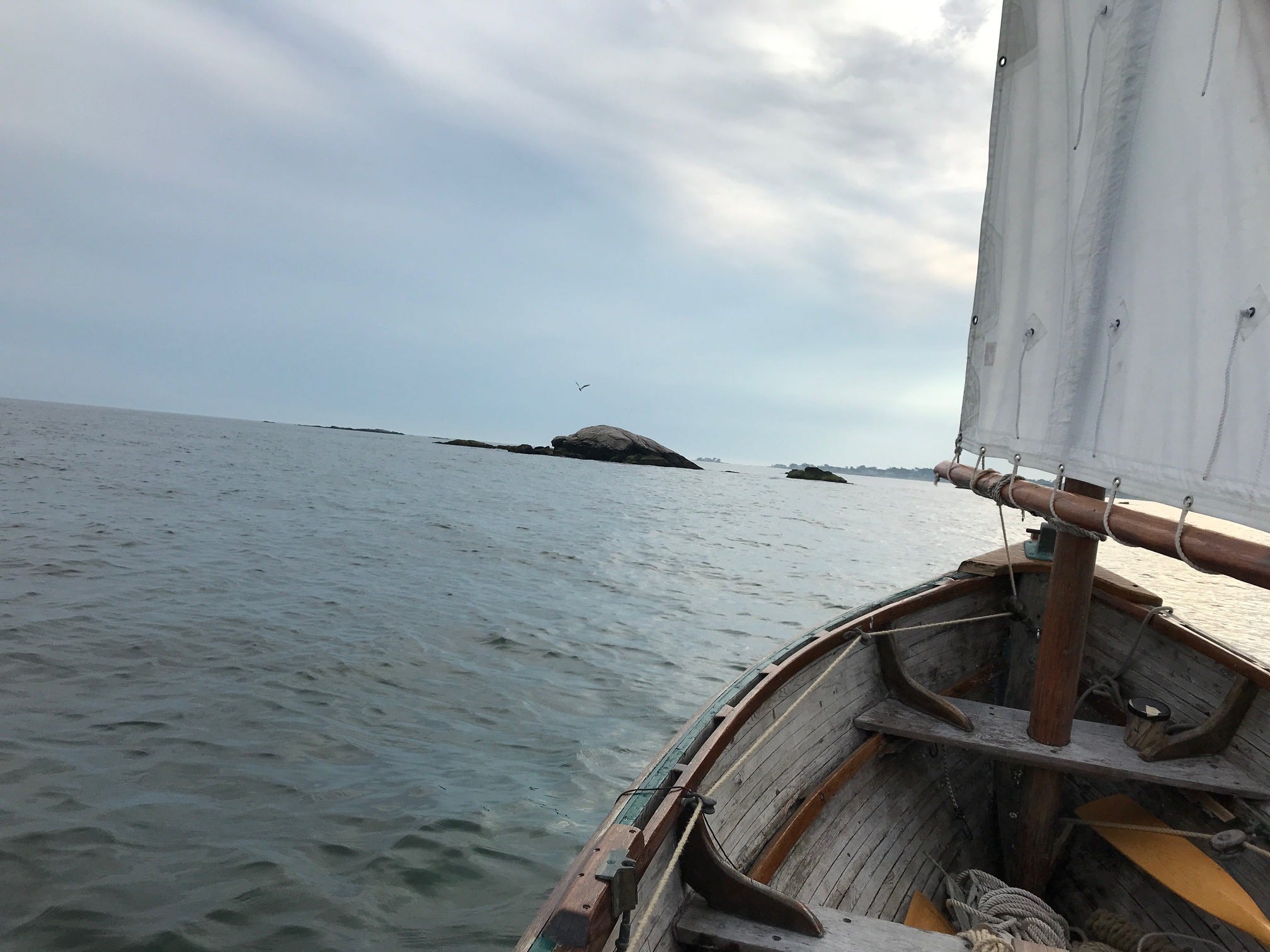
Within minutes I’ve sailed out of sight and the pounding bass and drums from the dockside bar have faded to a faint thumping, the sound waffling across the water for miles. It’s now too late to visit my father’s gravesite. Instead, I head for Hallock Bay, for the silence and peace of the wildlife sanctuary that surrounds it. I will anchor there for the night. Tomorrow I will again work the tide and make sure this time I make the entrance to Sterling Basin.
So interesting!!! Great job!
The story of Louie remains incredible, even after having read an earlier draft and knowing what's coming! I do think there is room for more about Louie. You tell the story as an amusing anecdote, but there is so much pain and pathology in the story as well. Another incidence of your mother's deeply troubled nature (in case there was any doubt that her scheme regarding your father's identity might be an anomaly); potentially putting her children in danger-- she didn't know who this Louis was. There's your father's withdrawal, your shame and social humiliation; and at last, Louie as a psychological mirror. There you all were, living in your future fantasies (you do speak to that.) Not to mention, of course, the racial politics, which is dealt with somewhat in the parallel with the Amistad story... So much here!